

What are the noise reduction technologies in automotive industry production equipment?
Hey there! As a supplier in the automotive industry production equipment field, I've seen firsthand how crucial noise reduction technologies are. In this blog, I'll share some of the key noise reduction technologies used in automotive industry production equipment.
Why Noise Reduction Matters
First off, let's talk about why we even care about reducing noise in automotive production. Excessive noise in the production environment can lead to a bunch of problems. For workers, it can cause hearing loss and other health issues over time. It can also make communication difficult on the factory floor, which might lead to mistakes and lower productivity. And from a business perspective, noisy equipment can be a turn - off for customers during factory tours or when they're evaluating our products.
Sound - Absorbing Materials
One of the most common noise reduction technologies is the use of sound - absorbing materials. These materials work by converting sound energy into heat energy. For example, we often use acoustic foams in our Automotive Water Tank Airtightness Testing Equipment. These foams are designed with a porous structure that traps sound waves. When the sound waves enter the pores, they bounce around and lose their energy, which reduces the overall noise level.
Another type of sound - absorbing material is fiberglass insulation. It's a great option for larger pieces of equipment. We've used fiberglass insulation in some of our heavy - duty production machines to dampen the noise generated during operation. It's relatively inexpensive and easy to install, making it a popular choice in the industry.
Vibration Isolation
Vibration is a major source of noise in automotive production equipment. When a machine vibrates, it transfers that energy to the surrounding environment, creating sound waves. To combat this, we use vibration isolation techniques.
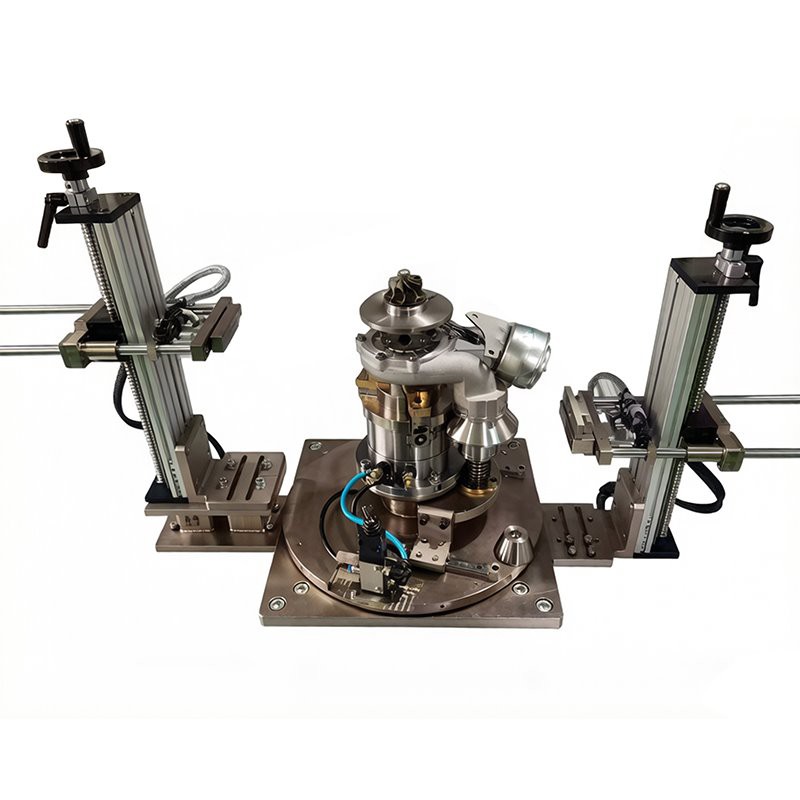
One common method is to use rubber mounts or pads. These are placed between the equipment and the floor or other supporting structures. The rubber material absorbs the vibrations, preventing them from being transmitted to the ground and reducing the noise. For instance, in our Automotive Turbocharger Compressor Housing Assembly Equipment, we use high - quality rubber mounts to isolate the vibrations generated by the assembly process.
Another approach is to use spring isolators. Springs can provide a more flexible form of vibration isolation. They can be adjusted to suit the specific requirements of different equipment. By using spring isolators, we can fine - tune the isolation and achieve better noise reduction results.
Enclosures and Barriers
Enclosures are a great way to contain the noise generated by production equipment. We can build custom - made enclosures around our machines. These enclosures are usually made of sound - insulating materials like steel or composite panels with a layer of sound - absorbing material on the inside.
For example, our Automotive Turbocharger Actuator Assembly Equipment is often placed inside an enclosure. The enclosure not only reduces the noise that escapes into the factory environment but also protects the equipment from dust and other contaminants.
Barriers can also be used in a similar way. They can be placed around the equipment to block the direct path of sound waves. These barriers can be made of various materials, such as plastic or metal, and can be easily installed and removed as needed.
Active Noise Control
Active noise control is a more advanced technology. It works by using microphones to detect the sound waves generated by the equipment. Then, a computer system analyzes the sound and generates an anti - noise signal. This anti - noise signal has the same amplitude but opposite phase to the original sound wave. When the two waves meet, they cancel each other out, effectively reducing the overall noise level.

Although active noise control is more expensive and complex to implement, it can be very effective, especially for low - frequency noise. We're starting to explore the use of active noise control in some of our high - end production equipment to provide even better noise reduction for our customers.
Maintenance and Design Improvements
Regular maintenance of the equipment is also important for noise reduction. Worn - out parts can cause increased noise. For example, if a bearing in a machine is worn, it can create a lot of noise during operation. By replacing these parts in a timely manner, we can keep the noise level down.
In addition, good design can also contribute to noise reduction. When we design our production equipment, we take into account factors like the shape of the components, the way they are assembled, and the materials used. For example, using smooth surfaces and proper alignment can reduce friction and noise.
Conclusion
In conclusion, noise reduction in automotive industry production equipment is a multi - faceted challenge. We use a combination of sound - absorbing materials, vibration isolation, enclosures, active noise control, and good maintenance and design practices to achieve the best results.
If you're in the market for automotive industry production equipment and are concerned about noise levels, we're here to help. Our team of experts can work with you to find the best solutions for your specific needs. Whether it's a small - scale production line or a large - scale manufacturing facility, we have the experience and technology to provide you with high - quality, low - noise equipment. Don't hesitate to reach out to us for a consultation and let's start a conversation about how we can meet your production requirements.
References
- "Noise Control in Industrial Environments" - A comprehensive guide on industrial noise reduction techniques.
- "Automotive Production Equipment Design and Maintenance" - A book that covers various aspects of automotive production equipment, including noise reduction.